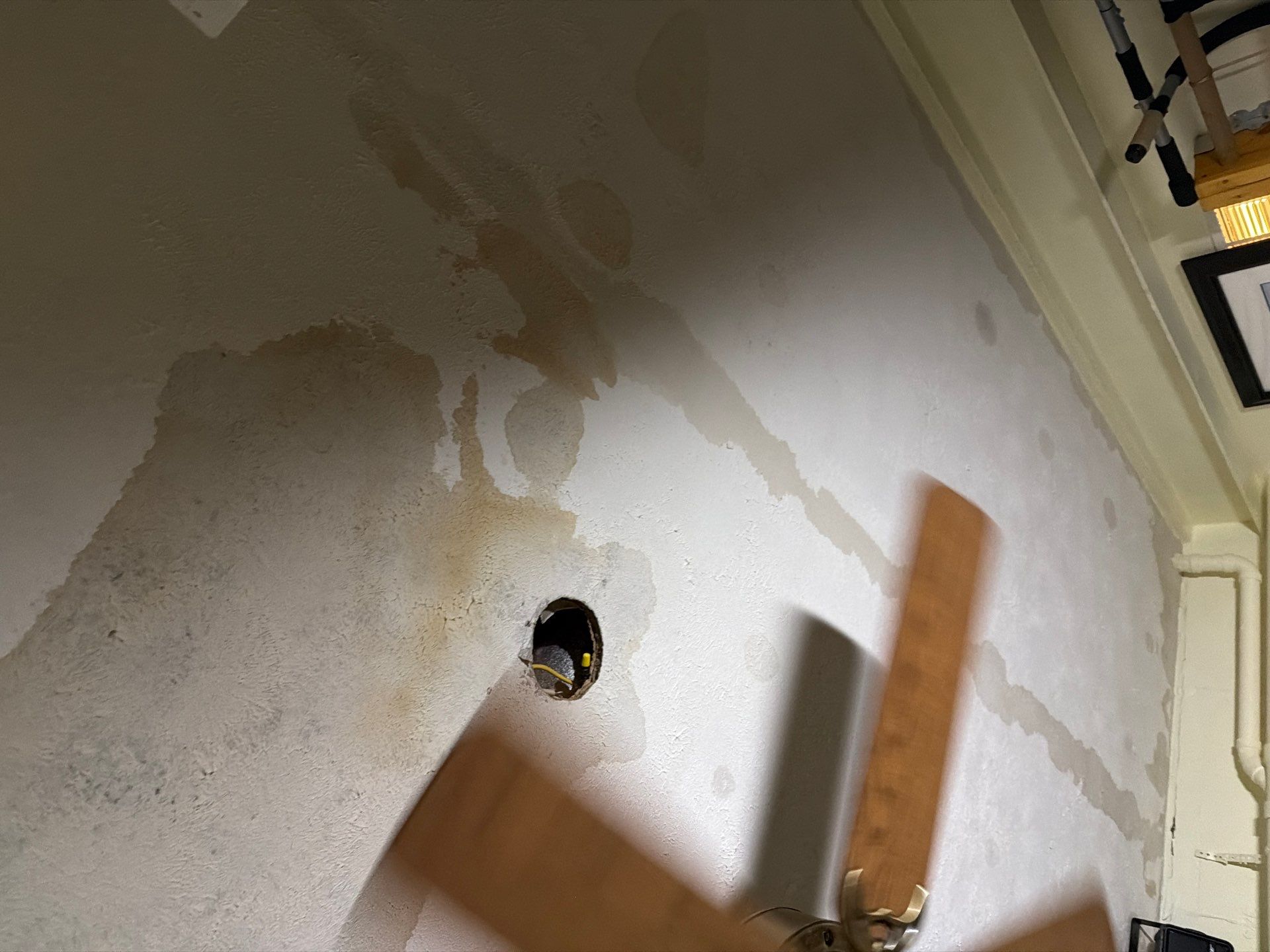
Quick Answer: How Much Drywall Usually Comes Out
For most residential losses in Imperial Hills, the amount removed depends on three factors: water category, wet height, and how long the wall stayed saturated. Here is the short version before we get into detail.
- Category 1 (clean water), caught in 24 to 48 hours: often no removal, dried in place with cavity ventilation.
- Category 1, wet over 48 hours or with wet insulation: 2 foot flood cut is typical.
- Category 2 (grey water): 2 to 4 foot cut, insulation discarded.
- Category 3 (sewage or floodwater): full removal to at least 12 to 24 inches above the highest wet line, often to the ceiling.
- Ceiling drywall sagging or stained through: remove the affected sheet entirely.
How We Decide What Stays and What Goes
Drywall is gypsum sandwiched between paper. The paper feeds mold, and the gypsum holds moisture deep in the core long after the surface feels dry. Before we cut anything, our techs map the affected area with a pinless meter and a thermal camera so the removal line is based on data, not guesswork. For a deeper look at how we read those readings, see our guide on signs of hidden water damage in your home.
Inspection Steps Before Any Cuts
- Identify the water source and stop active intrusion.
- Classify the water (Category 1, 2, or 3) per IICRC S500.
- Measure moisture content at the base, mid wall, and 4 foot mark.
- Check insulation type: fiberglass, cellulose, or closed cell foam.
- Inspect for pre existing mold, paint type, and wall construction.
- Document with photos and a moisture map before demolition.
When Imperial Hills Water Restoration crews arrive in Imperial Hills, in most cases within 2 hours, this inspection sequence runs before any saw touches the wall. Skipping it leads to one of two bad outcomes: overcutting walls that could have dried, or undercutting walls that go on to grow mold behind a fresh paint job. The moisture map also becomes the baseline we compare against during daily drying checks, so we know whether the equipment placement is actually working.
What Happens After the Cut
Once wet materials are out, we set containment, run air movers and dehumidifiers, and monitor daily until framing and bottom plates hit dry standard. Only then does rebuild start. Cutting drywall and walking away is not drying. The cavity has to reach equilibrium, or new drywall will trap moisture and grow mold within weeks.
Typical Drying Timeline
- Days 1 to 2: aggressive evaporation, highest dehumidifier output, daily meter checks.
- Days 3 to 4: framing moisture drops into the teens, air movers repositioned to chase the last wet pockets.
- Day 5 or later: dry standard confirmed, equipment pulled, rebuild scheduled.
Standard Cut Heights by Scenario
The table below shows the cut heights our Imperial Hills crews use most often. These are starting points. Actual cuts follow moisture readings on your specific wall.
| Scenario | Typical Cut Height | Insulation |
|---|---|---|
| Clean supply line, dried within 24 hours | None, dry in place | Keep if dry |
| Clean supply line, 48+ hours wet | 2 feet (flood cut) | Remove wet sections |
| Dishwasher or washer overflow, grey water | 2 to 4 feet | Remove fully |
| Sewage backup, Category 3 | 12 to 24 inches above wet line | Remove fully |
| Long undetected leak with mold | To nearest stud beyond mold + 2 feet | Remove and bag |
| Ceiling leak, sagging panel | Entire sheet | Remove and inspect |
Why 2 Feet Is the Common Number
The 2 foot flood cut exists because water wicks up gypsum roughly 12 to 18 inches against gravity, and cutting at 2 feet gives a clean horizontal line that meets standard drywall sheet dimensions. It also gets the cut above most baseboards and electrical outlets so the rebuild stays simple.
Questions Homeowners Ask Before We Cut
Two questions come up on almost every Imperial Hills job. First, can the drywall be dried in place to avoid cuts entirely? Sometimes yes, if the water was clean, the wall has no insulation, and we arrive fast enough. Second, will insurance cover the rebuild? In most documented losses, yes, because our moisture maps and photos give the adjuster what they need. Imperial Hills Water Restoration handles that paperwork side by side with the drying work so you are not chasing two timelines at once.
When the Cut Goes Higher
Several conditions push the removal line well above 2 feet. If you see any of these in your Imperial Hills home, expect more demolition.
- Visible staining, blistering, or bubbling paint above the 2 foot mark.
- Wet blown in insulation that has slumped inside the cavity.
- Category 3 contamination from sewage or river flooding.
- Mold growth confirmed by inspection, which often pairs with our mold removal after water damage protocols.
- Two story wicking where water traveled up through the bottom plate.
- Plaster veneer or skim coat that traps moisture against the drywall core.
- Vinyl wallpaper or oil based paint trapping moisture behind a vapor barrier.
- Double layer drywall in older garages or party walls, where the back sheet stays wet far longer than the visible face.
Ceiling Drywall: Different Rules
Ceilings act differently than walls. Gravity pulls water down, and the paper backing on the top side of the sheet stays wet much longer than the painted face below. Our standard call: if the ceiling is sagging, stained through, or shows any soft spots, the sheet comes out. Spot repairs almost never hold because the seam between old and new tape rarely matches. For more on this, our breakdown of ceiling water damage repair covers the full scope.
What We Save When Possible
- Trim and baseboard, if removed carefully before the cut.
- Electrical outlets and switches, after drying and inspection.
- Wall framing, which dries well with directed airflow.
- Hardwood and tile finishes adjacent to the cut zone.
- Crown molding and chair rail, when pried with a wide flat bar instead of pulled.